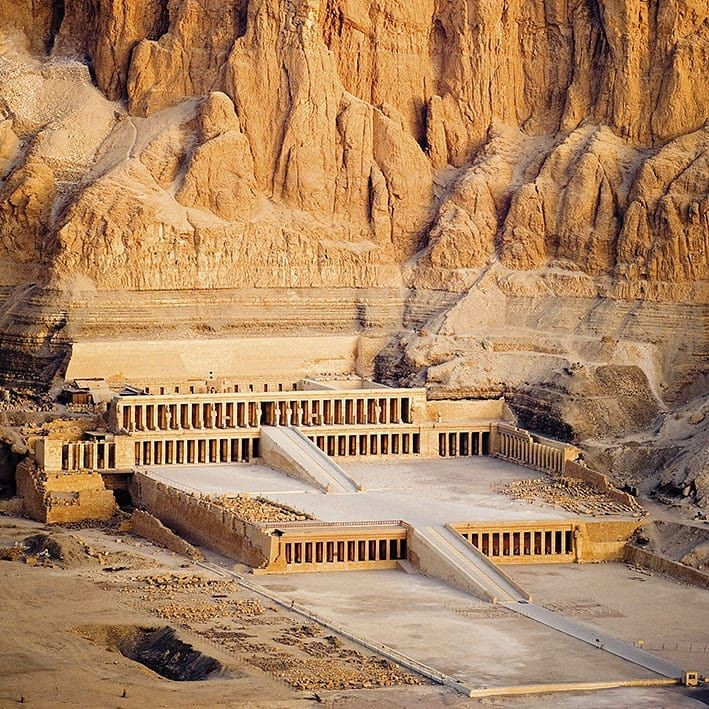
Quick Answer The Temple of Hatshepsut is a terraced mortuary temple at Deir el-Bahari on Luxor's West Bank, built around 1470 BC for Hatshepsut, one of Egypt's few female pharaohs. Set against towering limestone cliffs, it is famous for its three colonnaded terraces, reliefs of a trade expedition to Punt and chapels to Hathor and Anubis. Allow about an hour for a visit. |
Few monuments in Egypt look as modern as the Temple of Hatshepsut. Its long, clean lines and wide ramps seem almost contemporary, yet it was built about 3,500 years ago. It also tells one of the most fascinating stories in Egyptian history: that of a woman who ruled as king. This guide covers Queen Hatshepsut history, the temple's highlights and practical advice for your visit.
Last updated: October 2026
Key Takeaways
- Hatshepsut ruled Egypt for around two decades, approximately 1479 to 1458 BC, during the 18th Dynasty.
- Her temple, called Djeser-Djeseru ("Holy of Holies"), was designed by her official Senenmut.
- Deir el-Bahari is on Luxor's West Bank, close to the Valley of the Kings.
- The temple features three terraces linked by ramps.
- It is included in most Luxor West Bank tours and Nile cruise itineraries.
Who Was Hatshepsut?
Hatshepsut was the daughter of Thutmose I and the wife of her half-brother Thutmose II. When Thutmose II died, the throne passed to his young son, Thutmose III, with Hatshepsut acting as regent. Within a few years, she took the full titles of pharaoh and ruled as king.
To strengthen her position, Hatshepsut was often shown in the traditional male royal image, wearing the false beard and kilt of a pharaoh. Her reign was largely peaceful and prosperous, marked by major building projects and trade missions. After her death, Thutmose III ruled alone, and later in his reign many of her images and names were removed from monuments. Historians still debate the reasons.
In 2007, Egyptian archaeologists announced the identification of Hatshepsut's mummy, which is now displayed at the National Museum of Egyptian Civilization in Cairo.
The Hatshepsut Mortuary Temple
A mortuary temple was a place where offerings and rituals honored the ruler after death. Hatshepsut's temple was also dedicated to the god Amun, as well as Hathor and Anubis. Its design was inspired partly by the older temple of Mentuhotep II, whose ruins stand beside it at Deir el-Bahari.
| Level | What You Will See |
|---|---|
| Lower terrace | Wide courtyard, ramp and colonnades with reliefs of obelisk transport |
| Middle terrace | Punt Colonnade, Birth Colonnade, Chapel of Hathor, Chapel of Anubis |
| Upper terrace | Osiride statues of Hatshepsut, Sanctuary of Amun cut into the cliff |
Highlights Not to Miss
The Punt Expedition reliefs
On the middle terrace, carvings show Hatshepsut's famous trading expedition to the Land of Punt, probably located along the southern Red Sea coast of Africa. Look for boats loaded with incense trees, exotic animals and the memorable figure of the Queen of Punt.
The Birth Colonnade
These reliefs tell the story of Hatshepsut's divine birth, presenting her as the daughter of the god Amun, a powerful claim to legitimacy.
The Chapel of Hathor
Columns topped with the face of Hathor, the goddess of love and music, mark this chapel. Some reliefs still retain bright colors.
The Chapel of Anubis
The ceilings here are painted with stars, and the colors of the reliefs are among the best preserved at the site.
The Osiride statues
The upper terrace is lined with tall statues of Hatshepsut in the form of Osiris, god of the afterlife, creating one of the most photographed views in Luxor.
Visiting the Temple of Hatshepsut
Getting there
The temple is on Luxor's West Bank, about 30 minutes by car from the East Bank hotels and cruise docks. From the ticket office and visitor center, a small electric train takes you to the temple entrance, or you can walk about 10 minutes.
Best time to visit
Deir el-Bahari is exposed to the sun, and the cliffs reflect heat. Visit early in the morning, ideally right after the Valley of the Kings, or later in the afternoon. In winter, morning light is perfect for photography.
How long to spend
Allow about 45 to 75 minutes, depending on how closely you study the reliefs.
Combine with other West Bank sites
The temple sits close to the Valley of the Kings, the Valley of the Queens and the Colossi of Memnon. A typical West Bank tour covers all of them in a single morning. For a spectacular aerial view, take a sunrise hot air balloon flight over Deir el-Bahari before your tour.
Practical Tips
- Wear a hat and sunscreen; there is little shade.
- Bring water and small notes for toilets and tips.
- Photography with personal cameras and phones is generally allowed.
- Take time on the middle terrace, where the best-preserved reliefs are found.
Explore Luxor's West Bank with Us
Our Egyptologist guides bring Hatshepsut's story to life. Discover the Colossi of Memnon, view our 5-Day Luxor to Aswan Nile cruise or contact us for a private West Bank tour.