Quick Answer Edfu Temple, the Temple of Horus, is widely considered the best-preserved ancient temple in Egypt. Built between 237 and 57 BC during the Ptolemaic period, it still has its roof, towering pylon, inner sanctuary and walls covered in inscriptions. It lies on the West Bank of the Nile, about halfway between Luxor and Aswan, and is a standard Nile cruise stop. |
If you want to know what an Egyptian temple looked like when it was in use, go to Edfu. Here you walk through a complete building, from the gateway to the dark sanctuary, almost exactly as priests did over 2,000 years ago. This guide covers Edfu temple history, the reasons it survived so well and what to see during your visit.
Last updated: October 2026
Key Takeaways
- The temple is dedicated to Horus, the falcon-headed god of kingship.
- It took about 180 years to complete, from Ptolemy III to Ptolemy XII.
- Its main pylon is around 36 meters high, one of the tallest in Egypt.
- Buried under sand for centuries, it was cleared in the 19th century by Auguste Mariette.
- Nile cruise guests usually reach the temple by horse carriage from the dock.
Edfu Temple History
The temple of Horus Edfu was begun in 237 BC under Ptolemy III and completed in 57 BC under Ptolemy XII, the father of Cleopatra VII. Although built by Greek-speaking rulers, the temple follows traditional Egyptian design and religious ideas, and the Ptolemies are shown on its walls as Egyptian pharaohs.
The site was sacred long before the Ptolemies. According to myth, Edfu was the place where Horus fought his uncle Seth to avenge the murder of his father Osiris. Each year, a great festival celebrated the sacred marriage of Horus with Hathor, whose statue traveled by boat from her temple at Dendera to Edfu.
After the decline of the ancient religion, the temple was gradually buried by sand and covered by village houses. This sand actually protected it. In the 1860s, the French archaeologist Auguste Mariette led its clearance, revealing a nearly intact building.
Why Is Edfu the Best-Preserved Egyptian Temple?
Several factors explain why Edfu is often called the best preserved Egyptian temple:
- It was built relatively late, so it had less time to decay.
- Its location on higher ground protected it from Nile floods.
- Sand and debris buried and shielded it for centuries.
- It was not used as a quarry for stone, unlike many older temples.
Layout and Highlights
| Area | What to See |
|---|---|
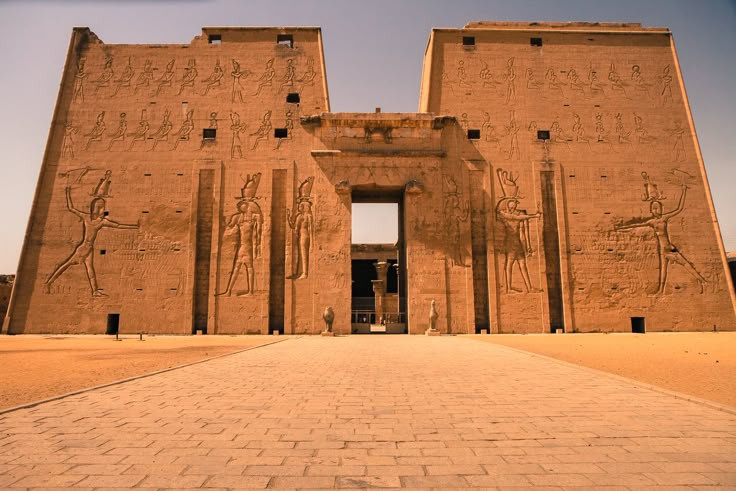
| The Pylon | Giant gateway with reliefs of the king striking enemies before Horus |
| Court of Offerings | Large open courtyard surrounded by columns |
| Granite Horus statues | Iconic falcon statues guarding the entrance to the hall |
| Hypostyle Halls | Two halls with massive decorated columns |
| Sanctuary of Horus | Granite shrine (naos) of Nectanebo II and a replica sacred boat |
| Ambulatory corridor | Reliefs of the battle between Horus and Seth |
| Nilometer | Stairway well used to measure the Nile's level |
The great pylon
At around 36 meters high, the pylon dominates the town. Its reliefs show Ptolemy XII smiting enemies before Horus and Hathor. Vertical grooves held flagpoles that once flew colored banners.
The granite falcons
Two granite statues of Horus in falcon form stand at the entrance to the hypostyle hall. They are among the most photographed sculptures in Egypt.
The sanctuary
The inner sanctuary contains a polished granite shrine from the reign of Nectanebo II, older than the temple itself, and a modern replica of the sacred barque that carried the god's statue in processions.
Horus and Seth reliefs
In the corridor around the temple, reliefs tell the story of Horus defeating Seth, who is shown as a small hippopotamus. These texts are an important source for understanding Egyptian drama and ritual.
Building inscriptions
The walls of Edfu carry long texts describing the temple's construction, measurements and rituals, making it a key source for Egyptologists.
How to Visit Edfu Temple
Getting there
Cruise ships moor at the Edfu riverbank. From there, most guests take a traditional horse-drawn carriage (calèche) through town to the temple, a ride of about 15 minutes. Carriage rides are often included in cruise excursions, though drivers expect a small tip. Some operators use minibuses instead.
Best time to visit
Most cruises visit Edfu early in the morning, which is ideal for cooler weather and good light. Mid-morning can be busy as several ships arrive together.
How long to spend
Allow about 1.5 to 2 hours including transport.
Practical Tips
- Make sure your carriage driver knows your ship's name and mooring point for the return trip.
- Agree any extra costs before the ride if carriages are not included.
- Bring a flashlight or use your phone light inside the darker rooms.
- Look for the original ceiling soot left by later residents, a reminder of the temple's long history.
See Edfu on Your Nile Cruise
Edfu is included on every one of our Luxor and Aswan itineraries. Continue to Kom Ombo Temple, browse our Nile cruises or contact us for availability.