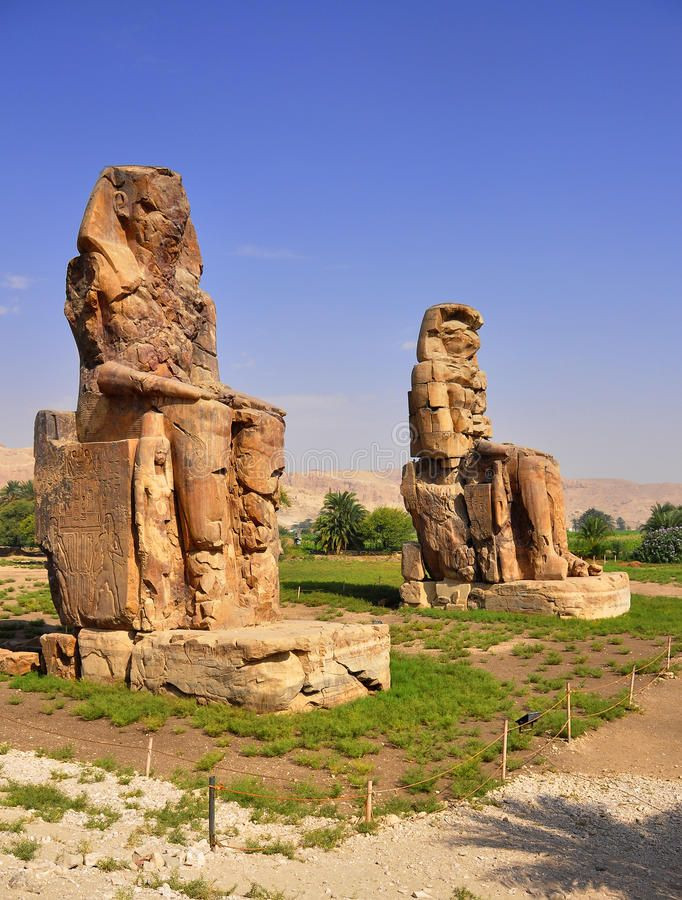
Quick Answer The Colossi of Memnon are two giant seated statues of Pharaoh Amenhotep III on Luxor's West Bank, each about 18 meters tall and carved around 1350 BC. They once guarded his vast mortuary temple. After an earthquake damaged one statue, it was said to "sing" at dawn, attracting Greek and Roman visitors who linked it to the mythical hero Memnon. |
For more than 3,000 years, two stone giants have sat in the fields of Luxor's West Bank, looking east toward the Nile and the rising sun. They are usually the first site travelers see on the West Bank, and often the most photographed. This guide reveals the history of the Amenhotep III statues, the legend of the singing statues Egypt became famous for and tips for your visit.
Last updated: October 2026
Key Takeaways
- The statues represent Amenhotep III, who ruled Egypt at the height of its wealth in the 14th century BC.
- Each colossus stands about 18 meters high, including its base.
- They were carved from quartzite sandstone brought from quarries far to the north.
- The statues stood at the entrance of what was once Egypt's largest mortuary temple.
- Visiting is free and takes about 15 to 20 minutes.
Who Built the Colossi of Memnon?
The statues were commissioned by Amenhotep III, a pharaoh of the 18th Dynasty who reigned for nearly four decades during a time of peace and prosperity. They show the king seated on a throne, hands resting on his knees. Smaller figures beside his legs represent his wife, Queen Tiye, and his mother, Mutemwiya. The sides of the thrones show the Nile god Hapi binding together the plants of Upper and Lower Egypt, a symbol of unity.
The colossi originally stood at the gateway of Amenhotep III's mortuary temple, a huge complex that may once have been larger than Karnak. Because it was built close to the river's flood plain, the temple was damaged by floods and later used as a source of stone. Today, archaeologists continue to excavate the site and have uncovered and re-erected further statues of the king.
The Legend of the Singing Statues
In 27 BC, an earthquake cracked the northern statue. Soon afterward, people noticed that at dawn it sometimes produced a soft sound, described as a whistle, a moan or the vibration of a string. The likely explanation is that rising temperatures and evaporating dew caused air or moisture to move through the cracked stone.
Greek visitors connected the sound with Memnon, a hero of the Trojan War and son of Eos, goddess of the dawn. According to their belief, Memnon was greeting his mother each morning. The statue became one of the most famous tourist attractions of the ancient world. Visitors, including the Roman emperor Hadrian and his wife Sabina in 130 AD, carved Greek and Latin inscriptions on its legs, many of which can still be seen.
Around 199 AD, the Roman emperor Septimius Severus is said to have repaired the statue. After this restoration, the singing stopped and was never heard again.
| Fact | Detail |
|---|---|
| Pharaoh | Amenhotep III, 18th Dynasty |
| Date | Around 1350 BC |
| Height | About 18 meters, including base |
| Material | Quartzite sandstone |
| Earthquake | 27 BC |
| "Singing" period | About 27 BC to around 199 AD |
| Location | Luxor West Bank, near Kom el-Hettan |
Why Visit the Colossi of Memnon?
Even after centuries of weathering, the colossi are a powerful sight. Their scale gives a sense of the ambition of Amenhotep III's reign, and their story links ancient Egypt with the Greek and Roman world. They are also among the easiest West Bank Luxor sites to visit: they stand beside the main road, require no ticket and need little walking.
How to Visit
Location
The statues stand on the main road leading from the Nile to the Valley of the Kings and Deir el-Bahari, so most West Bank tours stop here briefly.
Best time to visit
Early morning offers soft light and a good chance of photographing hot air balloons rising behind the statues. Late afternoon light is also beautiful.
How long to spend
Fifteen to twenty minutes is enough for photos and a short explanation from your guide.
Nearby West Bank Sites
- Valley of the Kings: royal tombs of the New Kingdom.
- Temple of Hatshepsut: the terraced temple at Deir el-Bahari.
- Valley of the Queens: home to the Tomb of Nefertari.
- Medinet Habu: the well-preserved mortuary temple of Ramses III.
- The Ramesseum: the mortuary temple of Ramses II.
Practical Tips
- Ask your guide to point out the ancient Greek and Latin graffiti on the northern statue.
- Keep a polite distance from vendors; a firm "no, thank you" is enough.
- Combine the visit with a sunrise balloon ride for an aerial view of the statues.
The Statues Today
Centuries of Nile floods, earthquakes and weathering have worn the statues' faces and details, yet they remain remarkably imposing. An international team of archaeologists has worked at the site of Amenhotep III's mortuary temple for many years, uncovering fallen statues, sphinxes and columns. Some of these colossal figures have been re-erected near the original gateway, giving a better sense of how grand the entrance once looked. Each visit may reveal new restoration work in progress.
Explore Luxor's West Bank
Discover the Temple of Hatshepsut, view our 5-Day Luxor to Aswan Nile cruise or contact us to plan a West Bank tour with an Egyptologist.