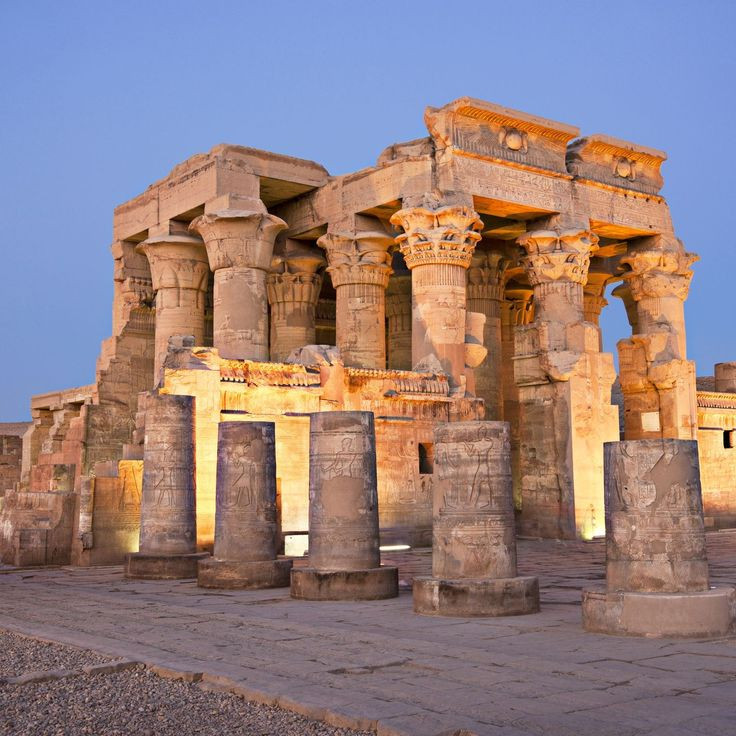
Quick Answer Kom Ombo Temple is a Ptolemaic-era temple on the Nile about 45 km north of Aswan. It is unique because it is a perfectly symmetrical double temple: the southern half is dedicated to the crocodile god Sobek and the northern half to the falcon god Horus the Elder (Haroeris). Next to it, the Crocodile Museum displays mummified crocodiles. |
Most Egyptian temples honor one main god. Kom Ombo honors two, with twin entrances, twin halls and twin sanctuaries side by side. Standing on a bend of the Nile, it is one of the most atmospheric stops on any Nile cruise, especially at sunset. This guide explains why the Kom Ombo double temple exists, what to see and how to visit.
Last updated: October 2026
Key Takeaways
- Kom Ombo sits on the East Bank of the Nile between Edfu and Aswan.
- Construction began under Ptolemy VI in the 2nd century BC and continued into the Roman period.
- The temple is split along a central axis into two identical halves.
- It contains famous reliefs often interpreted as medical instruments.
- Most Nile cruises stop here for a late afternoon or evening visit.
Why Is Kom Ombo a Double Temple?
In ancient times the area was home to many crocodiles, which basked on the sandbanks of the Nile. Local people worshipped Sobek, the crocodile god of fertility and the Nile's power, partly to win his protection. At the same time, Horus the Elder (Haroeris), the falcon-headed sky god, was an important deity across Egypt.
Rather than choose between them, the builders gave each god an equal half. Each side has its own entrance, hypostyle halls, offering rooms and sanctuary. Sobek's half is accompanied by Hathor and Khonsu, while Haroeris is worshipped with the goddess Tasenetnofret and their son Panebtawy.
| Feature | Southern Half | Northern Half |
|---|---|---|
| Main god | Sobek, the crocodile god | Haroeris, Horus the Elder |
| Associated deities | Hathor and Khonsu | Tasenetnofret and Panebtawy |
| Symbol | Crocodile | Falcon |
| Role | Fertility, Nile, protection | Sky, kingship, healing |
Highlights of Kom Ombo Temple
The twin entrances
As you approach, notice the two doorways side by side in the main façade, a clear sign of the temple's double dedication.
Medical instruments relief
On the inner enclosure wall, a well-known relief shows tools that many guides describe as surgical instruments, including scalpels, forceps, saws and medicine containers, alongside a seated goddess. Scholars debate their exact purpose, but the relief is a favorite with visitors interested in ancient medicine.
The calendar relief
Another wall carries a list of religious festivals and offerings organized by month, giving insight into the ancient Egyptian calendar.
The Nilometer
A circular well with stairs measured the level of the Nile flood. High readings meant a good harvest and, for the government, higher taxes.
Painted ceilings and columns
In the hypostyle halls, look up to see vultures with spread wings and traces of blue and red paint.
The Crocodile Museum Kom Ombo
Beside the temple, the Crocodile Museum Kom Ombo displays mummified crocodiles found in a nearby animal cemetery, along with crocodile eggs, coffins and statues of Sobek. Crocodiles were raised in the temple area, honored in life and mummified after death. The museum is small, air-conditioned and well presented, and entry is usually included with the temple ticket.
Sobek Temple Egypt: Where Else to See Sobek
Kom Ombo is the most famous Sobek temple Egypt offers, but Sobek was also worshipped in the Faiyum Oasis, where the town of Crocodilopolis was his center. You will also see crocodile figures in reliefs at other temples along the Nile.
How to Visit Kom Ombo Temple
On a Nile cruise
Most cruises moor directly beside the temple. Sailing from Luxor, ships usually arrive in the afternoon after visiting Edfu; sailing from Aswan, the visit takes place on the first evening. The walk from the dock takes only a few minutes.
Best time to visit
Late afternoon and early evening are ideal. The temple is lit up after dark, and the sunset over the Nile from the temple terrace is spectacular.
How long to spend
Allow about one hour for the temple and 20 to 30 minutes for the Crocodile Museum.
Practical Tips
- Combine the temple and museum in a single visit.
- Bring a light layer in winter, as evenings by the river can be cool.
- Keep small notes for tips and the restrooms.
- Expect a small market between the dock and the temple; bargaining is normal.
Kom Ombo at a Glance
Kom Ombo was more than a temple in ancient times. The town of Ombos controlled caravan routes from Nubia and the Eastern Desert, and later served as a base where the Ptolemies trained African elephants for war. Today the area around Kom Ombo is also home to many Nubian families resettled after the Aswan High Dam flooded their villages, so the region blends ancient and living heritage. Fields of sugarcane surround the town, and the temple's riverside setting makes it one of the most photogenic stops between Luxor and Aswan.
Visit Kom Ombo on Your Nile Cruise
Kom Ombo is included on all of our Luxor and Aswan itineraries. Read about Edfu Temple, browse our Nile cruises or contact us to start planning.