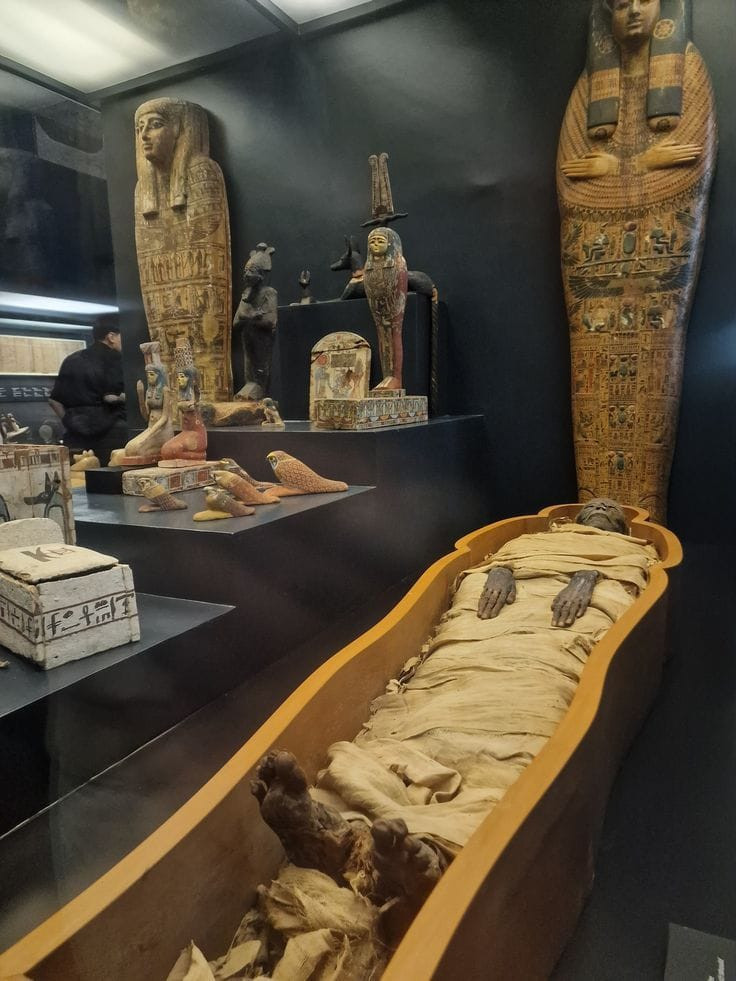
Quick Answer Ancient Egyptian mummies were made through a process of about 70 days. Embalmers removed the brain and internal organs, kept the heart in place, dried the body with natron salt for around 40 days, then anointed it with oils and resins and wrapped it in hundreds of meters of linen with protective amulets. The organs were stored in four canopic jars, and priests performed the Opening of the Mouth ritual before burial. |
Mummies are among the most fascinating legacies of ancient Egypt. They were not made to frighten anyone, but to give the dead an eternal body for the afterlife. This guide explains the Egyptian mummification process step by step, the role of canopic jars, the beliefs behind ancient Egyptian embalming and where you can see mummies on your trip.
Last updated: October 2026
Key Takeaways
- Mummification preserved the body so the soul could recognize and return to it.
- The full process took around 70 days.
- Natron, a natural salt from the Wadi el-Natrun area, dried the body.
- The heart stayed in the body because it was needed for judgment in the afterlife.
- Luxor has a dedicated Mummification Museum on the Corniche.
Why Did Ancient Egyptians Make Mummies?
Egyptians believed every person had several spiritual parts, including the ka (life force) and the ba (personality, often shown as a bird with a human head). After death, these needed a preserved body to return to. Without it, the person could not live forever.
The earliest Egyptians buried their dead in hot desert sand, which dried bodies naturally. Over time, as burials moved into tombs and coffins, artificial methods developed to achieve the same result. Mummification reached its most refined form during the New Kingdom, the age of the pharaohs buried in the Valley of the Kings.
The Egyptian Mummification Process: Step by Step
Step 1: Purifying the body
The body was taken to a tent called the ibu, the "place of purification", and washed with water from the Nile and palm wine.
Step 2: Removing the brain
Using a long hook inserted through the nose, embalmers broke up and removed the brain. Egyptians did not consider the brain important, so it was usually discarded.
Step 3: Removing the internal organs
An incision was made on the left side of the abdomen. The embalmers removed the lungs, liver, stomach and intestines, which decay quickly. The heart, believed to be the center of thought and emotion, was left in place.
Step 4: Drying with natron
The body was covered and packed with natron salt for about 40 days. Natron absorbed moisture and prevented decay. The removed organs were dried separately.
Step 5: Restoring the body's shape
After drying, the body was washed, rubbed with oils, spices and resins to keep the skin supple, and stuffed with linen, sawdust or other materials to restore a lifelike shape. Artificial eyes were sometimes added.
Step 6: Wrapping in linen
Embalmers wrapped the body in hundreds of meters of linen strips, coating layers with resin. Amulets were placed between the layers for protection, including a heart scarab over the chest. A priest read spells during the wrapping, which could take around two weeks.
Step 7: The mask and coffin
Wealthy individuals received a portrait mask, the most famous being Tutankhamun's gold mask. The mummy was placed in one or more nested coffins and, for royalty, a stone sarcophagus.
Step 8: The Opening of the Mouth ceremony
At the tomb, priests touched the mummy's mouth and eyes with ritual tools so the dead person could eat, speak and see in the afterlife. The burial followed, with food, furniture and treasures for eternal life.
Canopic Jars and the Four Sons of Horus
The dried organs were placed in four canopic jars, each protected by one of the Four Sons of Horus:
| Jar Lid | Son of Horus | Organ Protected |
|---|---|---|
| Human head | Imsety | Liver |
| Baboon head | Hapi | Lungs |
| Jackal head | Duamutef | Stomach |
| Falcon head | Qebehsenuef | Intestines |
In later periods, organs were often wrapped and returned to the body, while dummy canopic jars were still placed in tombs.
The Weighing of the Heart
According to Egyptian belief, the dead person traveled through the underworld to the Hall of Judgment. There, Anubis weighed their heart against the feather of Maat, goddess of truth. A light heart meant a just life and entry to the Field of Reeds, a perfect version of Egypt. A heavy heart was devoured by Ammit, a monster part crocodile, lion and hippopotamus. Spells from the Book of the Dead helped the deceased pass this test.
Who Was Mummified?
Pharaohs, nobles and wealthy families received the most elaborate treatment, but simpler mummification was available to others. Animals were also mummified in vast numbers, including cats, ibises, falcons and crocodiles, often as offerings to gods. You can see mummified crocodiles at the Crocodile Museum in Kom Ombo.
Where to See Mummies in Egypt
- Mummification Museum, Luxor: explains tools, materials and techniques.
- Valley of the Kings: tomb paintings show funerary rituals; Tutankhamun's mummy remains in his tomb.
- National Museum of Egyptian Civilization, Cairo: the Royal Mummies Hall.
- Crocodile Museum, Kom Ombo: mummified sacred crocodiles.
Discover Ancient Egypt's Secrets with an Egyptologist
Our guides explain mummification as you explore the tombs of Luxor. Meet the ancient Egyptian gods, browse our Nile cruises or contact us.