
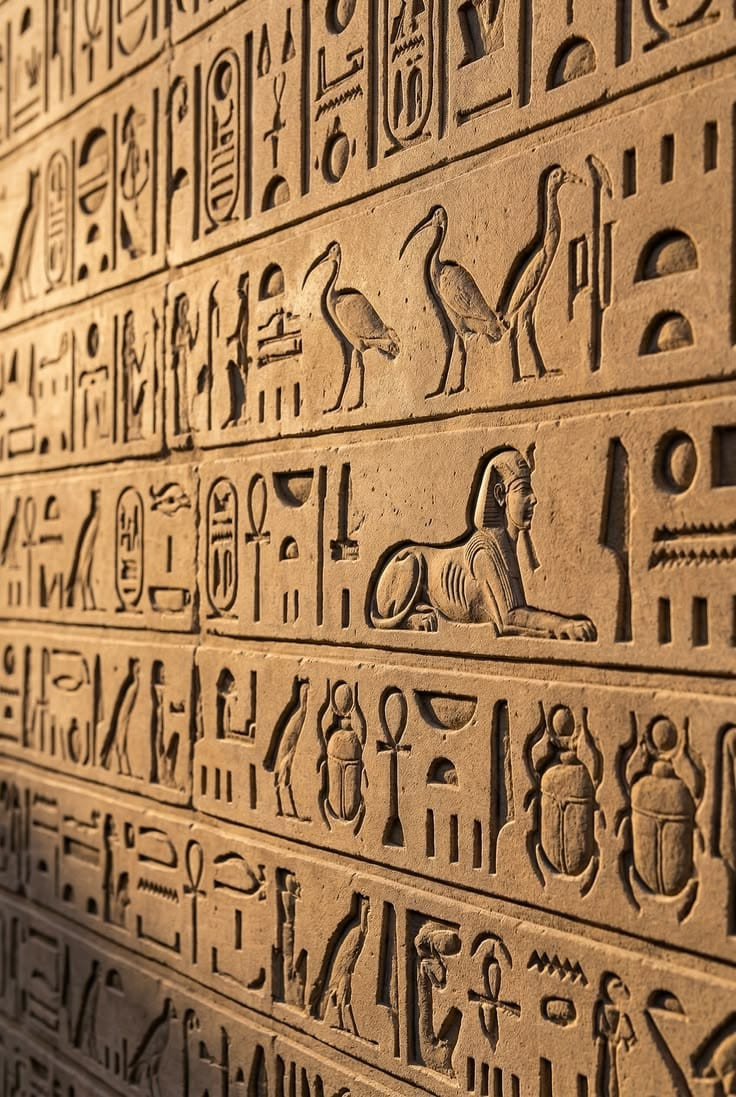
Quick Answer To read Egyptian hieroglyphics, first find the direction of writing (signs face the start of the line), then look for cartouches, the oval rings containing royal names. Most signs work as sounds (like an alphabet), as whole words or as silent "determinatives" that clarify meaning. Learning about 25 single-sound signs and a few common symbols such as the ankh lets you recognize names and key words on temple walls. |
Hieroglyphs cover almost every surface of Egypt's temples and tombs. To many visitors they look like beautiful but mysterious pictures. In fact, they form a complete writing system that you can begin to understand in an afternoon. This guide explains the basics, the story of the Rosetta Stone and a simplified hieroglyphics alphabet, so you can decode names on your Nile cruise.
Last updated: October 2026
Key Takeaways
- Hieroglyphic writing was used in Egypt for more than 3,000 years, from about 3200 BC to AD 394.
- The script was deciphered by Jean-François Champollion in 1822, using the Rosetta Stone.
- Hieroglyphs can be written left to right, right to left or in columns.
- Signs combine sounds, ideas and silent meaning markers.
- Royal names appear inside oval cartouches.
What Are Egyptian Hieroglyphs?
The word "hieroglyph" comes from Greek, meaning "sacred carvings". Egyptians called their script medu netjer, "the words of the gods". Hieroglyphs were used mainly for monuments, temples, tombs and religious texts. For everyday writing, scribes used faster cursive scripts called hieratic and, later, demotic.
There were around 700 to 1,000 common signs during the classical period, increasing to thousands in Ptolemaic times, when priests invented new signs and wordplay. That is why temples like Edfu and Kom Ombo are especially rich in complex inscriptions.
The Rosetta Stone and the Decipherment
After the last hieroglyphic inscription was carved at Philae in AD 394, knowledge of the script was lost for centuries. In 1799, French soldiers found a granite slab near the town of Rashid (Rosetta) in the Nile Delta. The Rosetta Stone carries the same decree from 196 BC, issued under Ptolemy V, written in three scripts: hieroglyphic, demotic and ancient Greek.
Because scholars could read Greek, the stone offered a key. The English scientist Thomas Young made early progress, but it was the French scholar Jean-François Champollion who announced in 1822 that hieroglyphs combined sound signs and meaning signs. Building on royal names in cartouches such as Ptolemy and Cleopatra, he cracked the system. The Rosetta Stone is now in the British Museum in London.
How to Read Egyptian Hieroglyphics: Step by Step
Step 1: Find the direction of writing
Look at signs showing people, animals or birds. They always face the beginning of the line, so you read toward their faces. If the birds face left, read from left to right. Columns are read from top to bottom.
Step 2: Look for cartouches
A cartouche is an oval ring with a line at one end. It encloses the name of a king or queen. Finding cartouches is the quickest way to identify which pharaoh built or decorated a wall.
Step 3: Learn the single-sound signs
About 25 signs represent single consonant sounds, similar to an alphabet. These help you sound out names and words. Egyptian writing generally did not write vowels, so names were read with vowels added by scholars.
Step 4: Recognize word signs
Some signs represent a whole word or idea. A drawing of a sun can mean "sun" or "day", and a house plan can mean "house".
Step 5: Spot determinatives
Determinatives are silent signs at the end of a word that show its category. A seated man indicates a male person, a seated woman a female, walking legs indicate movement and a sun disk relates to time.
Step 6: Read the scene
On temple walls, inscriptions explain the images beside them. Typically a pharaoh offers gifts to a god, and the text names both and records what the god promises in return, such as "life, stability and power".
A Simplified Hieroglyphics Alphabet
| Sign | Sound | Approximate English |
|---|---|---|
| Vulture | A | Glottal "a" |
| Reed leaf | I | "i" or "y" |
| Forearm | A (ayin) | Guttural "a" |
| Quail chick | W | "w" or "u" |
| Foot | B | "b" |
| Stool | P | "p" |
| Horned viper | F | "f" |
| Owl | M | "m" |
| Water ripple | N | "n" |
| Mouth | R | "r" |
| Reed shelter | H | "h" |
| Folded cloth | S | "s" |
| Pool | SH | "sh" |
| Basket with handle | K | "k" |
| Jar stand | G | "g" |
| Bread loaf | T | "t" |
| Hand | D | "d" |
| Cobra | DJ | "j" |
Common Hieroglyphs and Their Meaning
Understanding a few Egyptian hieroglyphs meaning will make temple visits richer:
- Ankh: a cross with a loop on top, meaning "life".
- Djed pillar: stability and endurance, linked to Osiris.
- Was scepter: power and dominion.
- Eye of Horus: protection and healing.
- Scarab: rebirth and the rising sun.
- Shen ring: eternity and protection; the cartouche is an elongated shen.
Tips for Practicing on Your Nile Cruise
- Look for the cartouches of Ramses II at Karnak and Luxor Temple; they appear everywhere.
- At Kom Ombo and Edfu, compare the dense Ptolemaic inscriptions with older New Kingdom texts.
- Ask your Egyptologist to write your name in hieroglyphs; many guides love to do this.
- Buy a cartouche pendant with your name in Luxor or Aswan as a meaningful souvenir.
Decode the Walls with Our Egyptologists
Our licensed guides love teaching guests to read the walls of Karnak and Edfu. Explore ancient Egyptian symbology, meet the ancient Egyptian gods or contact us .