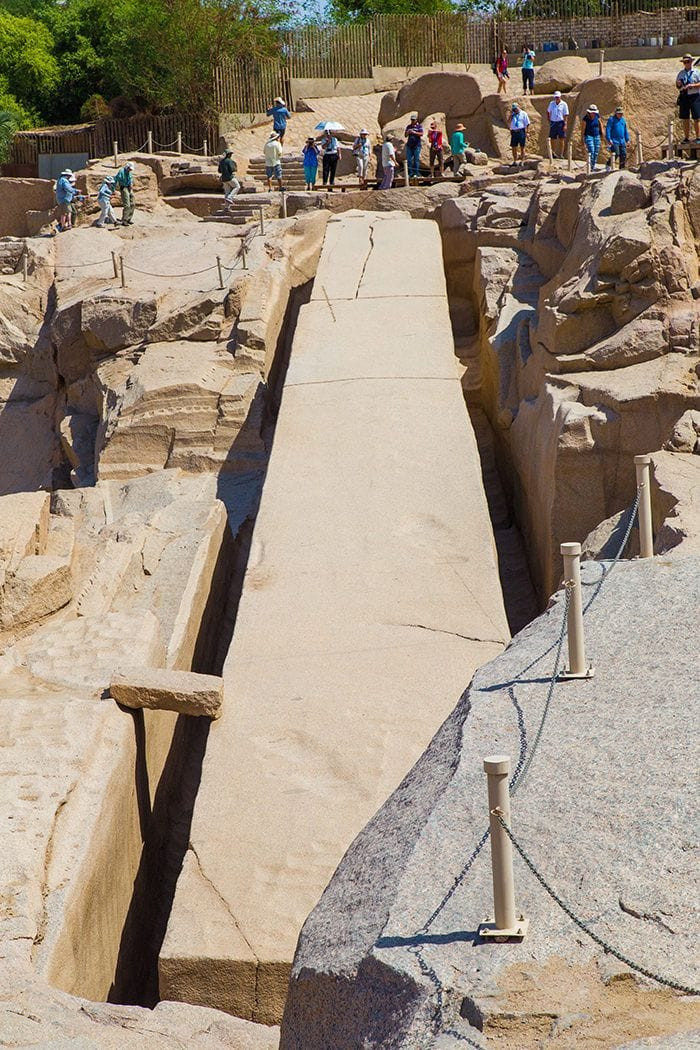
Quick Answer The Unfinished Obelisk is a giant obelisk still lying in an ancient granite quarry in Aswan. Had it been completed, it would have been about 42 meters tall and weighed roughly 1,100 tonnes, around a third larger than any obelisk ever raised in ancient Egypt. Workers abandoned it after cracks appeared in the granite. Today it offers a rare look at how obelisks were made. |
Ancient Egyptian obelisks stand in Luxor, Rome, Paris, London and New York, but how were these single blocks of stone carved and moved? The best answer lies in a quarry in Aswan, where one obelisk never left the ground. This guide explains the unfinished obelisk Aswan story, the methods used to make it and why the obelisk was abandoned.
Last updated: October 2026
Key Takeaways
- The obelisk lies in the Northern Quarries of Aswan, close to the city center.
- It is commonly dated to the New Kingdom and often linked to the reign of Hatshepsut.
- Its estimated length is about 42 meters and weight about 1,100 tonnes.
- Cracks in the granite made it impossible to finish.
- The site shows tool marks and techniques used by ancient quarry workers.
What Is an Obelisk?
An obelisk is a tall, four-sided stone pillar that tapers to a pyramid-shaped tip called a pyramidion. Ancient Egyptian obelisks were usually carved from a single block of granite and erected in pairs at temple entrances. They were associated with the sun god Ra, and their tips were sometimes covered in gold or electrum to catch the first rays of sunlight.
Pharaohs commissioned obelisks to honor the gods and celebrate their reigns, inscribing their names and titles on the sides. Karnak Temple, Luxor Temple and Heliopolis once held many of them.
The Aswan Granite Quarry
Aswan was the source of Egypt's finest red and pink granite, a very hard stone ideal for statues, sarcophagi and obelisks. The Aswan granite quarry areas stretched along both banks of the Nile. From here, enormous blocks were floated downstream on barges during the flood season to Luxor, Memphis and beyond.
The Northern Quarry, where the Unfinished Obelisk lies, is now an open-air museum. Walkways allow you to look down on the obelisk and see the trenches cut around it.
Why Was the Obelisk Abandoned?
As workers shaped the obelisk, cracks appeared in the granite. The largest runs across the stone and would have caused the obelisk to break when lifted or erected. Workers seem to have tried to reduce the design to a smaller obelisk, but further flaws made this impossible as well. Faced with failure, they abandoned the project, leaving the giant stone attached to the bedrock where it still lies today.
| Fact | Detail |
|---|---|
| Location | Northern Quarries, Aswan |
| Estimated length | About 42 meters |
| Estimated weight | About 1,100 tonnes |
| Material | Aswan red granite |
| Probable period | New Kingdom, often linked to Hatshepsut |
| Reason abandoned | Cracks in the granite |
How Were Obelisks Carved?
The quarry offers valuable evidence of ancient techniques:
- Choosing the stone: quarrymen searched for a long, flawless section of granite.
- Preparing the surface: the top layer was leveled, possibly using fire and water to weaken the outer rock.
- Pounding the trenches: workers used balls of dolerite, a stone harder than granite, to pound narrow trenches around the obelisk. You can still see the rounded pounding marks.
- Undercutting: once the sides were free, workers had to cut beneath the obelisk to separate it from the bedrock.
- Moving the obelisk: it would have been dragged on sledges to the Nile and loaded onto a barge during the flood.
- Raising the obelisk: at its destination, it was likely raised using earthen ramps and sand pits.
Experts estimate that hundreds of workers would have pounded the stone for months. The precision of their work, achieved without iron tools, remains impressive.
What the Unfinished Obelisk Teaches Us
Finished obelisks show the end result; the Unfinished Obelisk shows the process. It reveals the planning, organization and skill behind Egypt's greatest monuments, and reminds us that not every project succeeded. For many travelers, standing beside it makes the obelisks of Karnak and Luxor more impressive.
Visiting the Unfinished Obelisk
The site is a short drive from central Aswan and is usually combined with the High Dam and Philae Temple on the same morning. Allow 30 to 45 minutes. The quarry is exposed to the sun, so visit early, wear a hat and bring water.
Famous Obelisks Around the World
Many Egyptian obelisks were carried abroad. Ancient Rome removed several, and the Lateran Obelisk in Rome, originally from Karnak, is the tallest ancient obelisk standing today at about 32 meters. In the 19th century, obelisks traveled to Paris, London and New York; the two in London and New York are known as Cleopatra's Needles, though they predate Cleopatra by more than a thousand years. Most were quarried in Aswan, which makes the Unfinished Obelisk the starting point of their story.
Discover Aswan's Ancient Engineering
The Unfinished Obelisk is included on our Aswan sightseeing tours. Read about Karnak's standing obelisks, explore our Nile cruises or contact us.